
Custom Parcel Locker Keypads for Easier Pickup and Reliable Daily Use
Someone arrives with a pickup code and expects the right locker to open. A courier has a line of parcels to load. In both moments, the keypad needs to feel simple and respond as expected. Keypado manufactures custom parcel locker keypads with metal keys, layouts shaped around your access process, and panels made to fit your locker cabinet. We can work from your enclosure drawing, controller requirements, and installation conditions to develop the key layout, mounting, connection, and optional backlighting. You get an input device designed for the way people use your lockers, whether they are collecting parcels at an apartment building or making deliveries at an outdoor station.


Obtenir un devis Citation


Clear code entry
Give recipients a straightforward way to enter a pickup PIN and collect their parcel.
Made for shared use
Metal keys and a metal front panel provide a durable contact point for busy locker locations.
A layout that follows your software
Match numeric, confirm, cancel, and other keys to the prompts on your screen.
A fit for your cabinet
Set the panel size, fixing points, and mounting style around your locker design.
Ready for your controller
Agree on the key map, wiring, and connector before the keypad goes into production.
Pickup should be the easy part
Make the moment at the locker feel as smooth as the system behind it.
The right details depend on how your lockers work
A residential pickup station, a courier hub, and a campus locker may use the same kind of code entry, but they do not always need the same keypad.
Keys and legends
Structure métallique
Cabinet integration
Electrical and lighting options
Keys and legends
- Choose the number of keys needed for PIN entry and other functions.
- Add confirm, cancel, or navigation keys where your user flow calls for them.
- Align symbols and wording with your screen instructions.
Structure métallique
- Discuss stainless steel keys and front panels for exposed, frequently touched surfaces.
- Select a finish that suits the locker cabinet.
- Review engraved legends for keys that will see repeated use.
Cabinet integration
- Provide the panel opening, fixing locations, and space behind the fascia.
- Discuss front or rear mounting based on how your locker is assembled.
- Plan the cable route so installation and servicing remain practical.
Electrical and lighting options
- Define the output, key map, pin assignment, and connector for your controller.
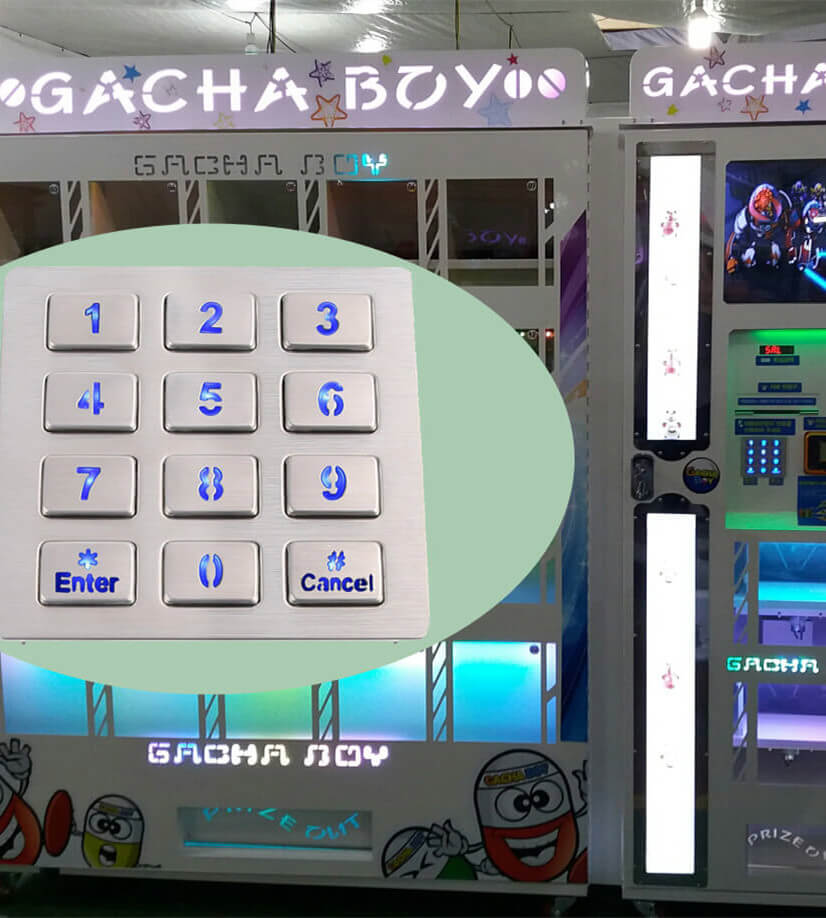
- Consider backlighting for dim entrances or outdoor pickup points.
- Confirm the lighting supply and electrical details as part of the approved design.
Applications Keypado
Pourquoi Keypado est votre choix

A keypad that makes pickup feel effortless
Your customer may be holding a phone, a bag, or a child’s hand while entering a collection code. The keys need to be easy to identify, and the action on the screen should match what happens when a key is pressed. We can develop a compact numeric layout for PIN entry, then add only the function keys your workflow needs. If couriers and recipients use the same locker terminal, we will consider both journeys when reviewing the legends and key arrangement. The aim is not to put more keys on the panel. It is to make the right key obvious.
Metal built for a public touchpoint
Parcel lockers sit in apartment lobbies, retail sites, campuses, and outdoor collection areas. The keypad is touched repeatedly by people who have never used your system before, so its feel and appearance matter. Keypado can develop a metal keypad with stainless steel contact surfaces and a panel that belongs with the rest of your cabinet. Key profile, spacing, finish, and markings can be reviewed together rather than chosen in isolation. If the locker will be exposed to rain, dust, or frequent cleaning, tell us early so the construction and protection requirements can be assessed for that installation.


The right signal for the right door
The keypad does not decide which locker opens. Your controller and software handle that logic; the keypad needs to send each input accurately. We can review a matrix key layout, wiring, pin assignment, cable, and connector against the controller you plan to use. If you need a different output, it should be discussed before the mechanical design is approved. This is especially useful when you operate several locker models: a panel can look identical from the outside while having different connections or key assignments behind it. Clear drawings help your team order and install the correct version.
Designed to fit the station, not interrupt it
A keypad that fits neatly into your locker fascia is easier for your team to assemble and easier to replace when needed. Start with the cutout, panel thickness, fixing positions, and available depth behind the mounting surface. We can then review the panel shape, mounting method, and cable exit with your enclosure design. An approved sample lets you check the fit and key operation in the actual station, not just on a drawing. For outdoor projects, evaluate the keypad as part of the installed panel so the agreed sealing approach reflects how the finished locker is built.

From locker design to approved keypad
We start with your access journey, then work through the hardware
Tell us how people use the lockers.
Walk us through pickup and delivery. Does a recipient enter a numeric PIN? Does a courier use the same terminal? Which actions need dedicated keys, and what does the screen tell users to do? Share your cabinet drawing, controller requirements, installation location, and expected quantity as well. If you already have a keypad, a sample or clear drawing gives us a useful starting point. These details help us propose something that fits the experience you are building, rather than a keypad selected only by its dimensions.
Agree on the details people will see and your team will install.
We will review the key arrangement, legends, panel finish, and mounting style alongside the locker fascia. Then we can confirm the key map, cable, connector, and any lighting requirements with your engineering team. For an outdoor station, we should also discuss the intended exposure and how protection will be assessed after installation. Before sampling, you should have a clear drawing and electrical definition to review, with no uncertainty about what a key is meant to do.
Test the sample in a working station.
Fit the sample into your cabinet and run through the same steps as a recipient and a courier. Check that each press appears correctly to the controller, the legends make sense beside the screen, and the mounting and wiring work for assembly. If backlighting is included, see how it looks in the intended location. Record any changes to key spacing, markings, or connection details. The approved sample becomes the reference for the configuration your team wants to buy.
Move forward with a defined production version.
Once the sample and drawings are approved, production can follow the agreed panel, keys, markings, and electrical connections. Where you have multiple locker generations or installation types, each version should have its own clear identification and documentation. That helps your purchasing and assembly teams avoid mixing similar looking parts. It also gives you a consistent reference when you expand a locker network or need to order the same keypad again.
FAQ
Yes. Send the cabinet cutout, panel thickness, fixing positions, and a photo or drawing of the current installation. If you have an existing keypad sample, it can help us review both the physical fit and the connection requirements.
Yes, a numeric layout can be designed around your PIN entry process. Your locker controller and software validate the code and decide which compartment opens; we focus on providing the key inputs they require.
It can, if your software supports both workflows through the same terminal. Tell us what each user needs to enter so the key arrangement and legends make sense for both delivery and collection.
Yes. Those keys can be useful when users need to complete an entry or correct a mistake. We will review their labels and positions against your on screen instructions.
Outdoor use can be considered during the design, but the required protection depends on the keypad and how it is installed in your cabinet. Share the expected exposure to rain, dust, temperature, and cleaning so we can discuss a suitable construction and test target.
Share the controller input specification, wiring diagram, or a sample of the current connection. We can then review the key map, pin assignment, cable, and connector before you approve the design.
Backlighting can be discussed for collection points with limited ambient light. Let us know what visibility you need and what power is available so the lighting can be assessed as part of the keypad design.
Yes, the legends can be reviewed for your user interface and market. Provide the exact characters or symbols you want, and check them on the approval drawing before sampling.
Install it in the locker and test the full pickup and delivery flow. Check every key input, the panel fit, cable routing, readability, and any agreed environmental requirements before approving production.
The most useful starting points are your key layout, cabinet drawing, controller requirements, installation environment, and expected order quantity. If some details are still open, share what you have; we can identify what needs to be confirmed next.
Quelques faits intéressants
Collaboration avec les partenaires mondiaux sur
 English
  Deutsch
  Français
  Polski
  Português do Brasil
  Español
  日本語
日本語  Русский
  العربية
  Italiano
  Nederlands
  Türkçe
  한국어
한국어